
10 March 2025
The rise of wheelchair mixed doubles curling
Mixed doubles has been a welcomed addition to the Olympic Winter Games, with its first two tournaments showcasing underdog upsets, elite dream-teams forming and romantic couples celebrating side-by-side on the podium. It was only a matter of time before mixed doubles would debut at the Paralympic Winter Games.
That moment arrives in just one year, marking the latest addition to the Paralympic programme. This follows just four years after the inaugural World Wheelchair Mixed Doubles Curling Championship.
New stars emerging
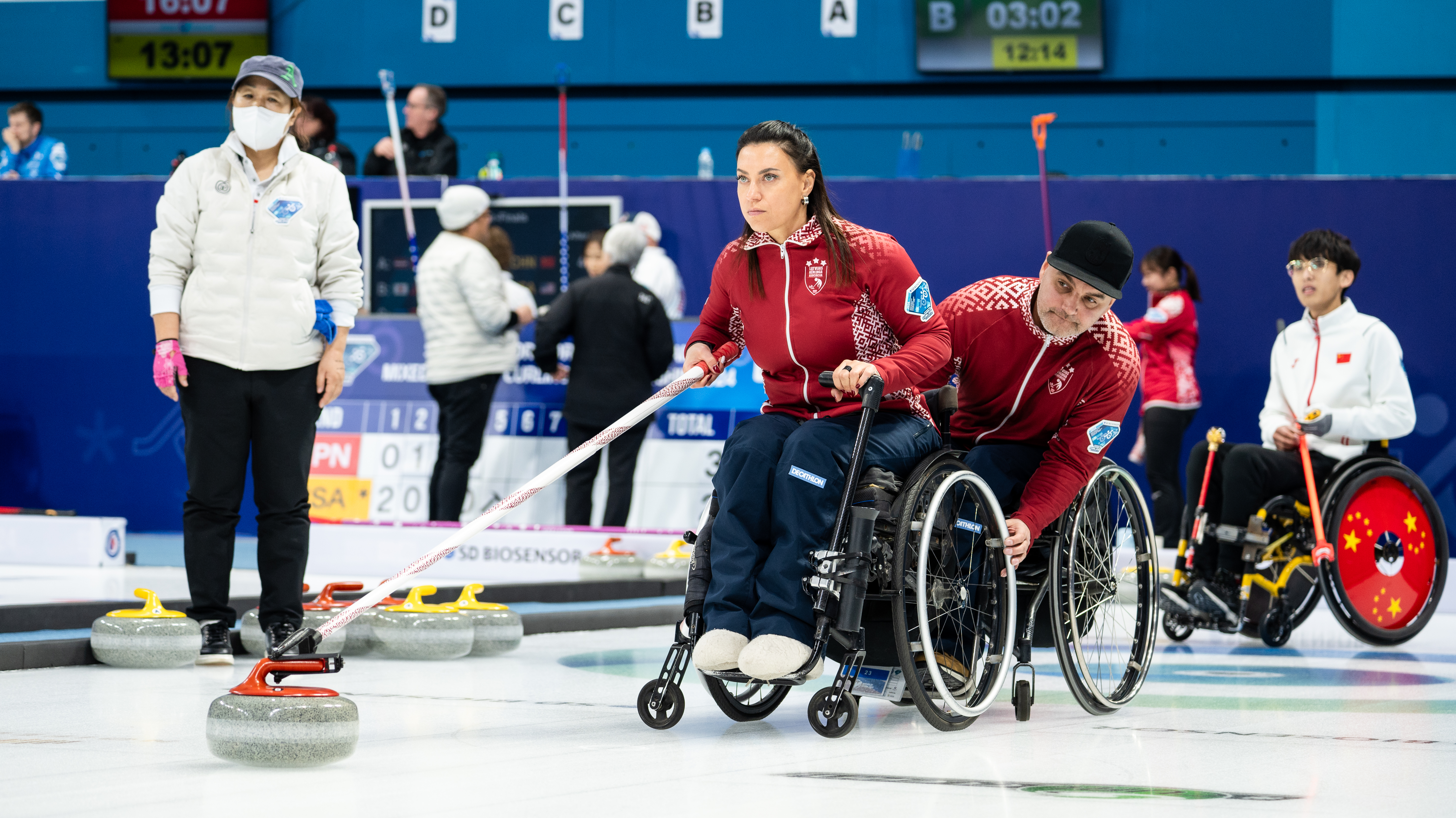
Much like the able-bodied version, wheelchair mixed doubles curling created new stars from rising countries. Whilst Hungary’s world silver medal in 2022 was one of those surprises, Latvia’s gold medal win in 2023 epitomises what the discipline aims to achieve.
Polina Rozkova, who has served as skip of the four-person team at several World Wheelchair Curling Championships, teamed up with Agris Lasmans and defied the odds to win gold.
Rozkova is a well-known figure in the curling world and has benefitted from the well-deserved spotlight after her win.
“Undoubtedly, this victory has allowed us to hope for a spot at the Paralympic Games and to pursue curling with even greater enthusiasm,” said Rozkova. “The financial opportunity to train has improved, although we would love to have more time on the ice.
“For the country and the curling community, this is a significant event that shows we are moving in the right direction.”
Off the ice, Rozkova and Lasmans have been giving back as inspirational para-athletes. They recently visited a social care home for children with disabilities, using their newfound fame to promote wheelchair mixed doubles curling.

Hard work happening off the ice
At the heart of the decisions made for the athletes at the Paralympic Games is Jiri Snitil, former skip of the Czech men’s national team. Now, he is an experienced technical delegate for wheelchair curling and is one of World Curling’s Competitions and Development Officers.
Despite the challenges of integrating a new event into the Paralympic programme, Snitil believes this is the move in the right direction.
“Everybody was hoping this new discipline would put wheelchair curling in an even better spotlight,” said Snitil.
“It proved itself to be a great decision because the games are quicker, and the two wheelchair athletes will be moving around the sheet much more than in the mixed team discipline.
“They’re helping each other hold the chair so sometimes they have nobody with the broom to show the target. Sometimes they would split and one would still give the target.”

New support element added
To support one player acting as a target, an Ice Player Assistant (IPA) is available in mixed doubles. This assistant holds the player’s chair which Snitil says adds “another piece in the game which we have never seen before”.
They praised the work of the IPAs at last year’s World Wheelchair Mixed Doubles Curling Championship, which saw many teams accept their support.
The IPAs are selected by local organisers and receive online training from World Curling prior to the competition, with on-ice training before the first round of games. However, Snitil noted that how much teams rely on the IPAs can influence tactics.
“We may have competitions where teams would not rely on their help as much.
“So, the interesting element is you see some teams practise how to throw stones even without support.
“Let’s say it’s the gold medal shot, and the shot is not made — that’s huge pressure on the player and the IPA.
IPAs are randomly allocated to sheets, but players’ feedback is considered during the latter stages of the competition. Those IPAs who have received particularly high praise are nominated for the final matches of the tournament, ensuring the best support is there during the most crucial moments.

High stakes and different dynamics
Both Rozkova and Snitil have high praise for the discipline, noting its high stakes and different dynamic to mixed team curling.
Before becoming a world champion, Rozkova was initially reluctant to embrace the mixed doubles format.
“I resisted mixed doubles for a long time — my heart was always with traditional team curling. But over time, the transition is happening, and I am falling in love with mixed doubles,” said Rozkova.
“Mixed doubles curling is an exciting and engaging game where the cost of a mistake is much higher than in traditional curling. Fewer stones mean greater game tension, but on the other hand, understanding your teammate is crucial.
“In mixed doubles curling, we are not just making our own shots; we are creating opportunities for our partner.”
Snitil describes the mixed doubles as a shorter game that requires quicker decision-making.
He also noted the increased gender equity this format brings, stating it was a “great opportunity” for emerging wheelchair curling nations.
Snitil suggested a future review of classification of athletes should be considered to improve accessibility to the sport, without compromising its integrity.
“If they can try and they can start with two players and have some success or participate at the world event, then they can come home and really start the programme and I really hope they can start some sort of snowball effect,” said Snitil.
“It seems to be difficult to be connected to the classification process where there may be somebody in a wheelchair or who is disabled but still not meeting the criteria, so it’s just also on us as a governing body to maybe review the classification rules.
“To allow a bit more participation and at the same time not disqualify the higher disabled players which we still have.
“So, it’s a thin line there to try increase the number of players without doing any sort of damage to what we already have.”

Wheelchair mixed doubles at the Paralympics
Due to the Milano Cortina 2026 Paralympic Winter Games competition schedule, the International Paralympic Committee (IPC) ruled out the possibility of players competing in both mixed doubles and the four-person mixed team events. With the Paralympics shorter than the Olympics, it means the two events will slightly overlap.
The mixed doubles final matches will take place at the same time as the opening days of the mixed team competition. Snitil suggests this overlap will be “very interesting for the spectators”, allowing mixed doubles its own spotlight on a quiet day of medal events.
“We had to be granted exception to start before the Opening Ceremony of the Paralympics which never happened before,” said Snitil. His next steps in preparations for the Games include overseeing an accessibility test with Milano Cortina 2026 organisers later this year, with hopes to have in-person training for the IPAs during this event.
For now, the attention returns to Stevenston, Scotland for the World Wheelchair and World Wheelchair Mixed Doubles Curling Championships, where Snitil and Rozkova will be seeking success both off and on the ice. For Snitil, it’s another chance to organise two great tournaments, while Rozkova aims to return to Latvia with another world title.
Join the World Curling community!
Follow us on Instagram, Facebook, X, TikTok, LinkedIn and Weibo and by searching the hashtag #curling #wheelchaircurling
Sign up for the World Curling Newsletter and receive monthly updates directly to your inbox.